The apple variety landscape in South Tyrol is the result of deliberate commercial selection across roughly a century of cooperative-led agriculture. Before the mid-twentieth century, the Adige Valley contained a considerably wider range of local and regional cultivars — many grown primarily for local consumption, cider production, or storage through winter. The consolidation toward export-oriented varieties accelerated significantly after World War II, driven by cooperative investment in cold storage infrastructure and access to northern European markets.
The Dominance of Golden Delicious
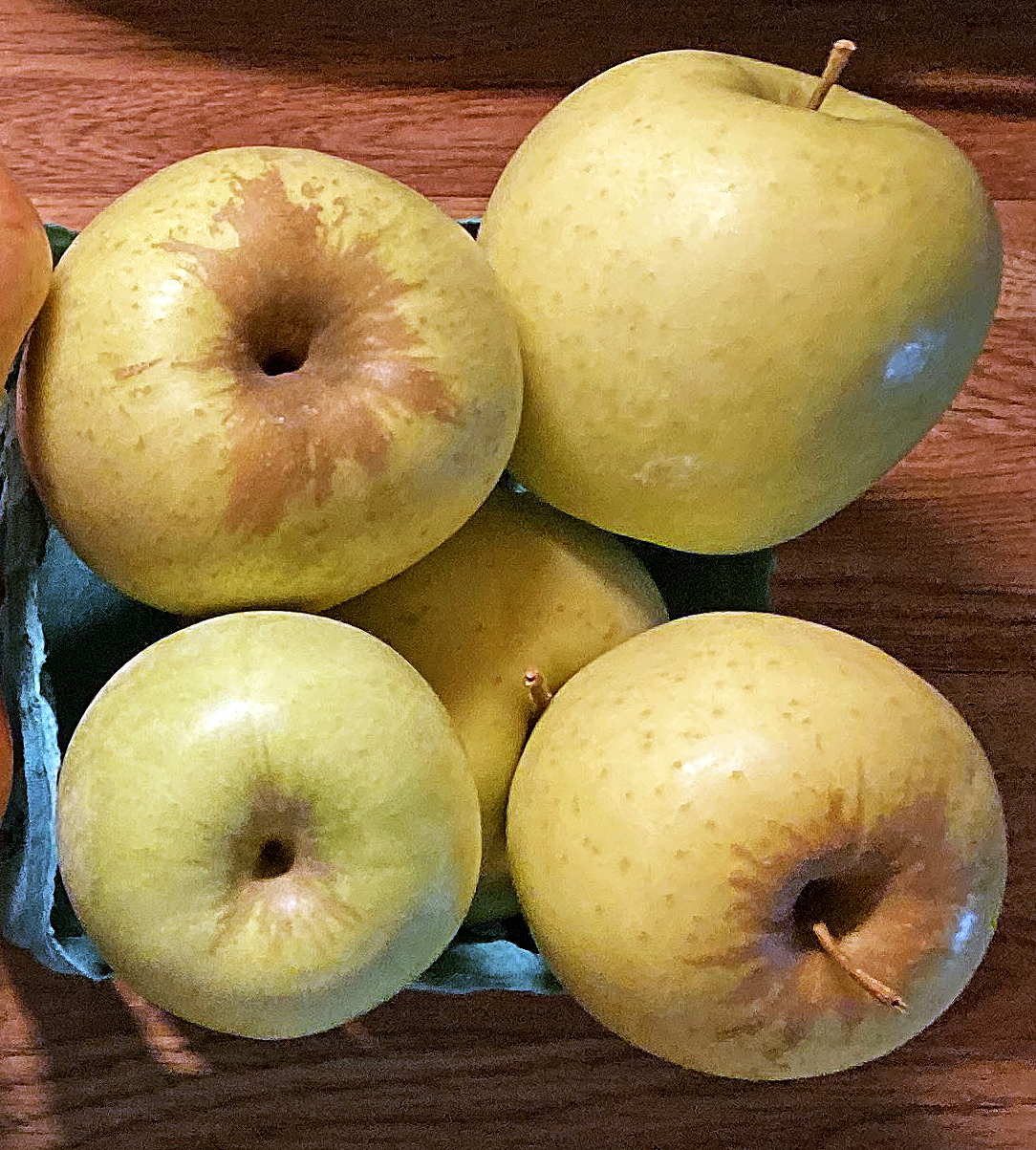
Golden Delicious arrived in South Tyrol from the United States in the 1930s but became the valley's defining commercial variety only from the 1960s onward. Its combination of long shelf life, resistance to bruising during mechanical harvesting, and predictable appearance on retail shelves made it the natural choice for the cooperative export model that VOG and VIP developed from that era.
At its peak in the 1980s and early 1990s, Golden Delicious accounted for well over 70 percent of total output by volume in some districts. That share has declined as consumer preferences have shifted toward sharper-flavoured, bicolour varieties, but Golden Delicious still represents the largest single variety planted across the IGP-registered surface area as of the most recent VOG production data.
Bicolour Varieties and the Shift After 2000
The period from roughly 1995 to 2015 saw systematic replanting toward bicolour varieties with stronger red colouration — a shift driven by retail buyer specifications from German, Scandinavian, and UK markets. Gala (and its mutations including Royal Gala, Galaxy, and Buckeye Gala) expanded rapidly across the valley floor and lower-altitude terraces. Fuji, which colours and sweetens more reliably at higher elevations, extended the cropping calendar into October and November for upper-elevation blocks above 600 metres.
Braeburn occupies a distinct position in the South Tyrolean portfolio. Originally from New Zealand, it performs well at elevations between 400 and 700 metres in the valley and produces a distinctive tartness that differentiates it from the sweeter dominant varieties. Braeburn is notably more sensitive to storage conditions, requiring tighter temperature management in controlled-atmosphere facilities — a constraint that has kept its total planted area below that of Gala and Fuji despite strong market demand.
Club Varieties and Managed Scarcity
From the early 2000s, a new tier of so-called club varieties entered the South Tyrolean market. These cultivars are governed by licence agreements limiting who can plant them and in what quantities — a deliberate mechanism to prevent the price erosion that affected Golden Delicious as plantings expanded globally.
Kanzi (a Gala × Braeburn cross developed in Belgium) and Envy (a Gala × Braeburn cross with New Zealand origins) are both grown in the Adige Valley under licence arrangements managed through the respective variety owners. Pinova, a variety developed by the Dresden-Pillnitz research station in Germany, is grown without club restrictions but with strong regional preference — it performs particularly well in the Vinschgau due to the district's high diurnal temperature variation, which promotes anthocyanin development in the skin.
Older Regional Cultivars
Alongside the commercial mainstream, a small number of traditional regional cultivars remain in cultivation, primarily on farms that supply local markets, farm shops, or distilleries. The Weißer Klarapfel (also called Weißer Sommerapfel) is one of the earliest-ripening varieties in the valley, typically ready by late July or early August. Its flavour profile — acidic, aromatic, and short-lived after picking — makes it unsuitable for the export cold chain but valued in farm-direct sales.
The Gravensteiner, a variety of Danish or German origin that arrived in the Tyrol in the nineteenth century, occupies a similar niche. It ripens in August, keeps poorly, and has largely disappeared from commercial plantings. Where it survives, it is often in mixed orchard blocks on older farms in the Bolzano uplands. The Gravensteiner's characteristic irregular shape and distinctive spicy-aromatic flavour attract attention from specialty food buyers and farm market visitors, though volume is minimal.
The Kronprinz Rudolf apple, a late-nineteenth-century variety once grown across the eastern Alpine zone, is documented in historical orchard records from the Merano area. Its current cultivation is limited to a handful of heritage orchard projects. Eurac Research in Bolzano has catalogued several dozen traditional cultivars from the region as part of its agrobiodiversity documentation work.
Variety Registration and IGP Compliance
The IGP Alto Adige specification maintained by the Mela Alto Adige consortium lists the authorised varieties eligible for labelling under the protected designation. Growers must register each orchard block by variety and provide annual harvest declarations. The specification sets minimum sugar content thresholds (measured in Brix) and minimum calibre (diameter) requirements that differ by variety — Golden Delicious faces different thresholds than, for example, Pinova or Braeburn.
Varieties not on the authorised list may still be grown but cannot carry the IGP label. This creates a clear commercial incentive for growers to replant older or unregistered cultivars with IGP-listed alternatives, which has contributed to the ongoing attrition of heritage varieties at the farm level.
Replanting Cycles and Variety Planning
An apple orchard in South Tyrol typically enters full production three to four years after planting and reaches economic peak productivity between years eight and twenty-five. The replanting cycle — triggered by declining yield, disease pressure, or market repositioning — is when variety decisions are made at the farm level, usually in consultation with the member's cooperative and its agronomic advisory team.
VOG and VIP both publish variety guidance to their member growers, and the autonomous province of South Tyrol maintains a vine and fruit cultivation register that tracks total planted surface by variety across the territory. Replanting incentive payments from provincial and EU rural development funds have, at various points, been conditioned on growers adopting specific varieties or rootstock combinations.
Sources: VOG annual production data; Mela Alto Adige IGP specification; Eurac Research agrobiodiversity documentation. Last updated: May 2026.

